
Poyters
The layered architecture is a well-established monolith architecture pattern that separates an application into interconnected layers, for instance: the presentation layer, the logic layer, and the data layer. This separation of concerns allows for better manageability, scalability, and flexibility in software development.
Layered architecture, also known as multi-layered or n-tier architecture, is an architecture pattern that organizes a system into distinct layers, each with specific responsibilities.
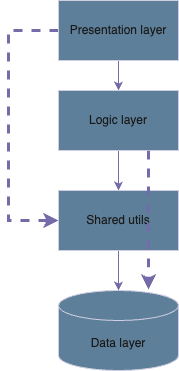
Layered architecture (left) and example of layered architecture (right)
In a layered architecture, each part of the system has specific tasks. For example, in the three-tier architecture, there are typically three main layers: presentation, business logic, and data access.
Each layer operates independently and communicates through well-defined contracts. These contracts describe how layers interact, ensuring smooth communication. As a result, layers can be replaced without affecting others, as long as they adhere to the established contracts. This flexibility allows for easy integration of new technologies while minimizing disruption to the overall system. For example, we can replace the presentation layer (using React.js) and replace it with a new presentation layer (Angular).
In addition, the layers can be open or closed.
The presentation layer is the topmost layer that interacts directly with the user. It consists of the user interface and presentation logic that displays data to the user and collects user inputs. Technologies commonly used in this layer include web technologies like HTML, CSS, and JavaScript, as well as frameworks like Angular, React, or Vue.js for web applications.
Also known as the logic layer or business logic layer, this middle layer handles the core functionality of the application. It processes user inputs, makes logical decisions, performs calculations, and coordinates the application’s overall operation. This layer is typically implemented using server-side programming languages and frameworks such as Java (Spring), C# (.NET), Python (Django), or Node.js.
The bottom layer is responsible for data management. It includes the database and data access logic, which stores and retrieves data as required by the application layer. Common technologies for this layer include relational databases like MySQL, PostgreSQL, and Oracle, as well as NoSQL databases like MongoDB and Cassandra.
This means that when the request goes from layer to layer, top to bottom, the request cannot skip any of them.
For example, in a closed three-layer architecture for a website, a request must go through all 3 layers
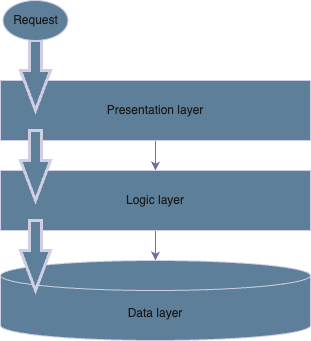
In an open layer architecture, a layer can bypass intermediate layers and communicate directly with any lower layer. This flexibility can improve performance by reducing the number of hops between layers but can also increase the complexity and potential for tight coupling between layers.
For example, the presentation layer could directly access the data layer for certain operations.
In this architecture pattern, decomposition is based on technology (as opposed to domain-based decomposition). This has some advantages and disadvantages.
The main advantages are clean boundaries for technical specialists (e.g. frontend and backend engineers). Each of them can develop separate layers, not really knowing anything about the other layers (they only need to know about the conctracts between them). Going forward, we can dedicate each layer to separate teams.
A serious drawback may be the dispersion of the business domain across all layers, which may result in difficult changes to it.
When employing a layered architecture pattern, it’s crucial to be mindful of common antipatterns that can arise:
Architecture by Assumption: This occurs when architectural decisions are made based on assumptions rather than concrete analysis or requirements. It can lead to mismatched layers or overly complex designs that don’t align with the actual needs of the system.
Accidental Architecture: Refers to situations where the architecture emerges organically without intentional design or planning. This can result in an inconsistent or poorly structured system, making it difficult to maintain or scale over time.
Sinkhole: This antipattern occurs when a layer in the architecture becomes a catch-all for various functionalities (similar to props drilling in React.js), violating the principle of separation of concerns. It can lead to bloated layers, decreased modularity, and increased complexity, undermining the benefits of a layered architecture.
| Feature | Layered Architecture | Modular Monolithic Architecture |
|---|---|---|
| Structure | Divides the application into distinct tech-based layers. | A single, cohesive application with distinct modules, each handling a specific business capability. |
| Scalability | Allows for independent scaling of each layer. | Scaling is done by deploying the entire monolith, which can be less efficient. |
| Flexibility | Enhances flexibility through clear separation of concerns. | Provides flexibility through modularity but can be harder to manage if the monolith grows too large. |
| Use Case | Ideal for applications requiring clear separation of concerns, scalability, and where different teams manage different layers. | Suitable for applications where modularity is desired, but the overhead of a microservices architecture is not justified. |
Layered architecture offers a robust framework for building scalable, maintainable, and secure applications by separating concerns into distinct layers. While it introduces some complexity, the benefits often outweigh the drawbacks, especially for larger and more complex systems.
On the other hand, modular monolithic architecture can be a simpler and more manageable alternative for smaller applications or when transitioning from a monolithic to a more modular design.
Choosing between these architectures depends on the specific needs of your project, including its size, complexity, and the development team’s expertise.
Happy coding!